


Humanoid Robots, the Race to Get Out into the Real World

Sabrina Pineda
Life News Today
China put its robotic future to the test in a competition that looked something like an Olympic Games for machines. The World Humanoid Robot Games, held in Beijing in August 2026, brought together 666 teams and 2,056 robots from 16 countries, including China, the United States, Germany, Japan and Brazil. During the competition, the machines participated in 51 events and 1,301 contests that included running, soccer, weightlifting and martial arts, as well as tasks related to factories, hotels, homes, logistics and emergency response.

One of the most striking events was the 100-meter race. A robot from the Tianjiao team, developed by X-Humanoid in Beijing, covered the distance in 8.64 seconds, below Usain Bolt’s human world record of 9.58 seconds. A year earlier, the winner of the first Games needed 21.50 seconds to cover the same distance. The improvement in speed was impressive, but it also exposed a less spectacular and possibly more important reality. Being fast does not necessarily mean being useful.
Some robots had trouble running smoothly around curves or handing off relay batons, but the more significant difficulties appeared in tasks that may seem simple to a person. Manipulating objects, using tools, tightening screws or performing other actions that require precision revealed just how difficult it remains to reproduce the dexterity of human hands. Then there is the ability to recognize that something has changed and decide what to do next. A machine can learn to perform one specific action extremely well and still have difficulty when it encounters something it did not expect.
And that is where so-called embodied AI becomes particularly interesting. Instead of limiting artificial intelligence to a computer or a screen, the idea is to give it a body capable of perceiving, moving and acting in the physical world. A curious example appeared in the 400-meter race. Tiangong Omni ran with its arms raised near its face and a pronounced movement of its hips, a technique its engineers said they had not directly designed. The movement emerged during reinforcement-learning training in simulations, where different strategies are tested repeatedly and those producing better results are reinforced. The posture looked strange for a human runner, but it worked, and the robot won the race in 45.66 seconds.
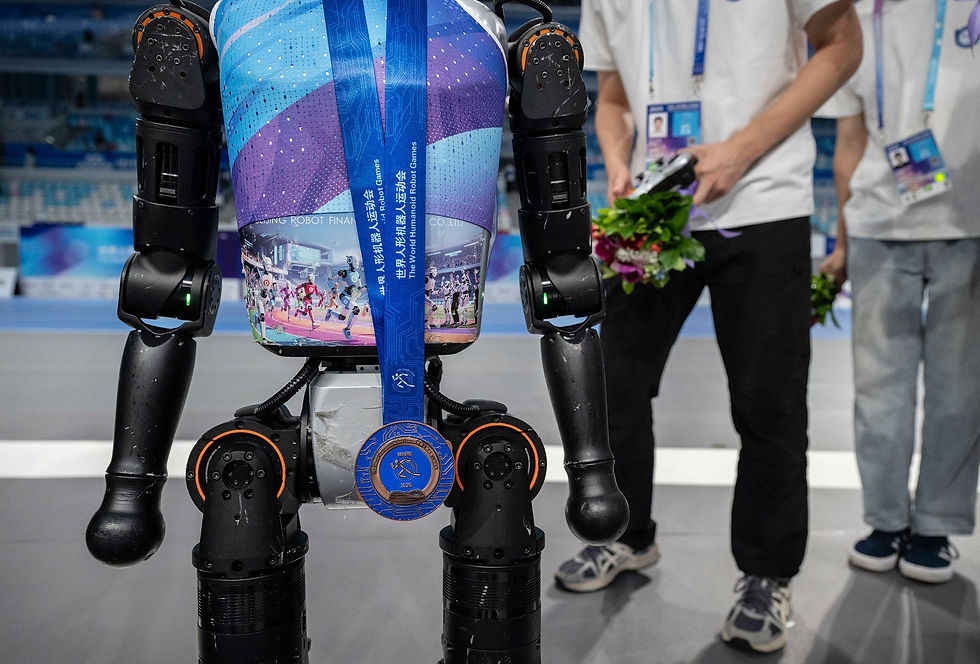
Technology also advanced in other disciplines. In the high jump from a static position, a robot reached 2.88 meters, compared to the 0.95 meters recorded in the 2025 Games. Chinese teams largely dominated the competitions and took the top places in most of the events with published results, especially in athletic disciplines. One of the most prominent exceptions was humanoid football, where Germany took the first two places with B-Human as champion and HTWK Robots Leipzig in second place, while the whIRLwind team from the Netherlands took third place.
But why is there so much interest in making these robots human-shaped? One reason is quite practical. The world around us was already built for us. Doors, stairs, tools, shelves, vehicles and workplaces are designed for people with two arms, two legs and hands capable of manipulating objects. In theory, a robot with a similar structure could enter those spaces without forcing a factory, hotel or warehouse to rebuild everything around it.
That does not mean the human form is always the best solution. A wheeled robot may be more efficient in a warehouse, and an industrial robotic arm can work faster and more precisely on a production line. Building a machine that walks on two legs, maintains its balance and manipulates objects with its hands adds enormous technical challenges and costs. The bet on humanoids, then, depends on that complexity producing an important payoff, a machine versatile enough to perform different jobs in places that were already designed for human beings.

China is looking to 2026 as a year of transition toward commercialization. A national initiative aims to put 10,000 humanoid robots into commercial operations and develop more than 100 application scenarios before the end of the year. In addition, a report presented during the World Robot Conference placed shipments by Chinese humanoid manufacturers at more than 40,000 during the first half of 2026, although other international estimates are lower. The Chinese government also expects domestic production to exceed 100,000 units during the year. The question now is whether that production capacity can translate into machines reliable enough to work outside testing environments.
For a business, it matters less whether a robot can do something extraordinary once than whether it can repeat a task correctly for hours. Battery life, energy consumption, mechanical failures and the ability to recover from an error can be just as important as speed or artificial intelligence. A factory does not need a robot that breaks a record and then stops. It needs one that keeps working.

Companies such as XPeng are already preparing for that next stage. The company plans to begin mass production of its IRON humanoid robot before the end of 2026, with commercial deliveries expected in 2027. For now, industrial and commercial environments offer much more controlled conditions than a home, where a robot would constantly have to deal with unpredictable objects, people and situations. Cost and reliability will be decisive factors in determining how far these machines can go.
China leads in humanoid production and commercialization, with a significant advantage in its supply chain, but it is not alone in this race. The United States is strong in artificial intelligence and software, with companies such as Tesla and Figure. Japan has a long history in robotics, while South Korea has a powerful electronics and manufacturing sector. In Europe, Germany continues to stand out in industrial robotics and manufacturing. The competition will come down to who can best combine hardware, cost and truly autonomous artificial intelligence.
The years 2026 and 2027 could show whether China’s industrial advantage translates into useful commercial robots or whether other countries manage to close the gap. For now, watching them run, jump and play soccer is impressive, but behind the spectacle lies a question far more important than who won a race. The real test will be whether those same machines can enter a place designed for people, understand what is happening around them, use the tools we use and perform a job reliably when things do not go exactly as programmed.


Comments