


Same roads, Unequal Odds of Survival
Francisco Casais, Reporters
Life News Today
Motorcycles and cars move through the same traffic system, but they do not move through it with the same protection. A car carries steel framing, seat belts, airbags, and an enclosed cabin designed to absorb force before it reaches the human body. A motorcycle does not. The rider remains exposed to the road, surrounding traffic, and the force of impact itself, relying on visibility, balance, judgment, and protective gear rather than a protective shell. The National Highway Traffic Safety Administration (NHTSA) says that, per vehicle mile traveled in 2024, motorcyclists were almost 27 times more likely than passenger car occupants to die in a motor vehicle crash and almost five times more likely to be injured. The Motorcycle Safety Foundation (MSF), in its operator manual, frames that exposure in a way that reaches beyond machinery alone, writing that “Safe riding depends as much on the mental skills of awareness and judgment as it does on the physical skill of maneuvering the machine.” Motorcycles and cars may share the same pavement, but they do not begin with the same physical margin for survival.

Intersections, curves, hills, and limited sight lines show how quickly a rider’s lack of structural protection becomes a life-or-death disadvantage when attention fails. One of the most common motorcycle crash patterns occurs at intersections, where a rider continues straight and another driver turns left across the motorcycle’s path, a sequence NHTSA identifies as a recurring factor in multi-vehicle motorcycle crashes. The roadway itself can deepen that vulnerability. Federal Highway Administration research and NHTSA safety guidance both emphasize that limited sight distance, curves, roadway surface conditions, and the simple fact that other drivers often do not see motorcycles in time can sharply reduce a rider’s room to react. On two wheels, a patch of gravel, an abrupt curve, a hill that blocks the view beyond it, a wet surface, or a sudden need to brake can turn a manageable condition into a loss of control faster than it would inside a passenger vehicle. Chrissy Nizer, Maryland’s highway safety representative, said in a Maryland safety campaign that “motorcycle crashes are preventable if we all take a moment to look twice and responsibly share the road.” For riders, the margin for correction is not merely smaller, it can disappear in the time it takes for a driver to glance, fail to register what is approaching, and move anyway.
Inexperience and access add another layer to the risk, particularly among younger riders who can enter the roadway with limited preparation. In many states, obtaining a motorcycle license involves fewer requirements than a standard driver’s license, lowering the barrier to be on the road. The process can include only a short basic course, sometimes completed in just a few hours, with limited on-road evaluation. While these courses introduce fundamental controls, they do not replicate the complexity of real traffic conditions or the split-second decision-making required to avoid danger. Motorcycles also remain one of the most affordable ways to access motorized transportation, placing them within reach of younger individuals who may lack both riding experience and risk awareness. This combination of lower licensing requirements and affordability can carry lasting consequences. When crashes occur, younger riders are more likely to suffer severe injuries and more likely to face permanent life altering damage.
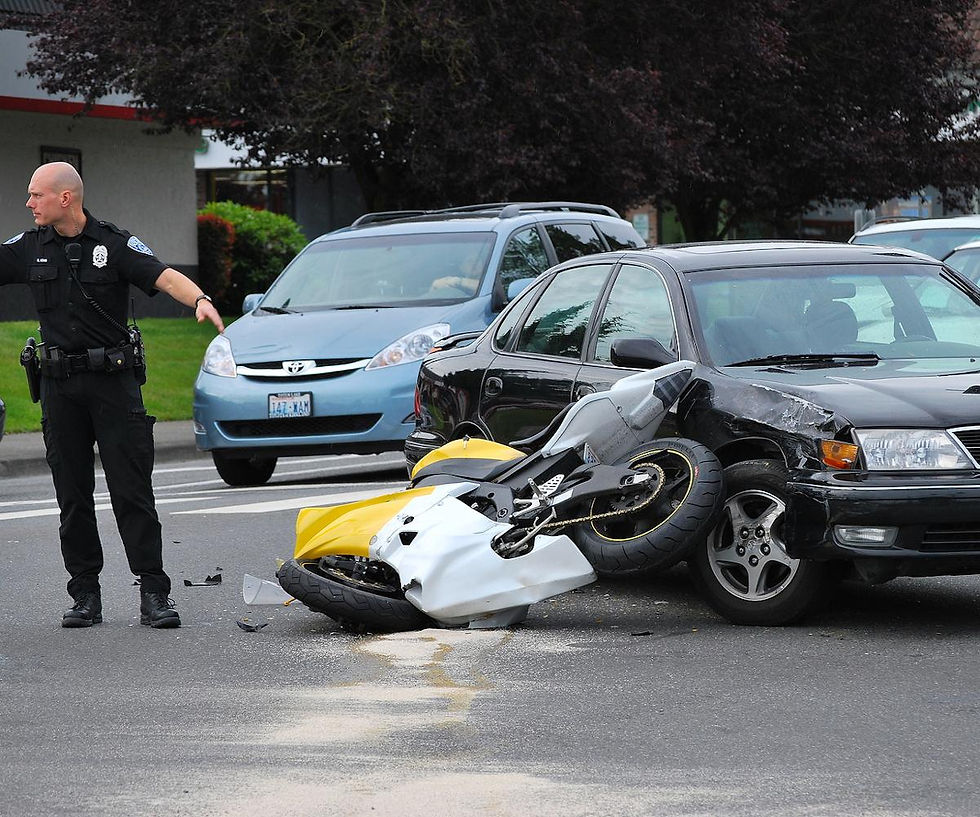
Crash outcomes separate sharply the moment control breaks down. A car occupant is more likely to remain inside a protective shell, restrained and buffered by systems designed to reduce blunt trauma. A motorcyclist is more likely to be ejected or to strike the roadway, another vehicle, or a fixed object directly. The Insurance Institute for Highway Safety (IIHS) reports that 6,335 motorcyclists died in crashes in 2023, the highest number recorded, and that motorcyclists accounted for 15% of all crash deaths that year. IIHS also says that, per mile traveled, deaths on motorcycles were nearly 28 times the number in cars. The Centers for Disease Control and Prevention (CDC) adds another layer to the same picture, reporting that helmets greatly reduce deaths and serious head injuries, including traumatic brain injury. Car occupants can still suffer severe harm, including whiplash, chest injuries from restraints, head trauma, and internal injuries, but the enclosed structure of the vehicle changes the body’s first contact with force. A rider often absorbs that force directly through the head, limbs, spine, shoulder, or neck.
Brachial plexus trauma shows how far the damage can reach beneath the visible violence of a crash. The brachial plexus is the network of nerves that carries signals from the spinal cord to the shoulder, arm, and hand. Those nerves control movement, sensation, and function across the upper limb. Damage there can turn a single crash into a lasting loss of strength, feeling, dexterity, or independence. These injuries can happen when the shoulder is forced downward while the head is driven in the opposite direction, or when the arm is violently pulled during impact. Mayo Clinic describes the injury spectrum as ranging from stretched nerves to tears and, in the most severe cases, nerves torn away from the spinal cord. Megan Jack, MD, PhD, a peripheral nerve neurosurgeon at Cleveland Clinic, explained the stakes in more individualized terms: “Each injury is so unique to that patient. So, we kind of approach it at that level.” Brachial plexus trauma does not produce one uniform condition or one uniform outcome.

Neuropraxia, rupture, and avulsion do not carry the same stakes. A stretched nerve may recover with time. A torn nerve may require surgical repair. A nerve pulled from the spinal cord can leave permanent loss behind. Dennis Kao, MD, a plastic surgeon in Cleveland Clinic’s brachial plexus program, described the most severe version with blunt clarity: “If we know for sure that it’s avulsed, then you don’t really need to wait because it’s never going to recover.” He added that if improvement and reinnervation do not appear within months, surgeons typically try to operate before the one-year mark. One person may recover sensation and movement over months. Another may spend years navigating surgeries, rehabilitation, and only get limited function. What begins at the roadway does not end at impact. It can move from visible trauma into nerve damage that reshapes work, self-sufficiency, and the ordinary mechanics of daily life.
Weakness, numbness, burning pain, loss of grip strength, and paralysis mark the next stage of that progression, where clinical language gives way to lived consequence. Treatment is not uniform because the injuries are not uniform. Mayo Clinic says care depends on the seriousness and type of the injury, the time that has passed since it occurred, and other existing conditions. Surgical options can include nerve grafts, nerve transfers, or muscle transfers, while milder injuries may depend more heavily on rehabilitation, monitoring, and time. Delays can matter. Recovery can stretch across months or years. Andrew McGrath, a motorcyclist quoted in a WMCHealth patient story about his recovery after a crash-related nerve injury, said, “I was nervous about the surgery because if something went wrong, it could mean the loss of my dexterity.” He later added, “I could not afford to lose any more function.” The quotes move the story from anatomy to daily life, from diagnosis to consequence, from nerve damage as a category to the possible loss of work, grip, movement, and control.

Cost, fuel use, maneuverability, and convenience matter, but they matter only after the physical risk is understood in full. Motorcycles generally cost less to buy, consume less fuel, and can move through congestion with greater ease. Cars usually demand more money upfront, but they return something far more consequential in a crash: structure, restraint, and distance between the body and the blow. Motorcycles and cars do not simply mark two modes of travel. They leave the human body facing radically different odds when impact comes. That is why training does not end with a license, and for new riders, it should not begin and end with a basic course. Additional instruction can make a measurable difference, especially in emergency response. Riders need to understand how to brake properly, how to avoid locking the front wheel, and how sudden over-braking can pitch the body forward and increase the risk of severe impact. They also need exposure to controlled techniques that reduce injury during a fall, including how to separate from the bike and avoid direct force to the head, neck, and spine. Without that preparation, instinct can take over in a crisis, and instinct is often wrong. The result can be catastrophic, including spinal injuries that permanently affect movement and independence. A motorcycle can be easy to access, but surviving a crash on one is not. The difference often comes down to training that goes beyond the minimum.


Comments