


Scotland, Wales and Northern Ireland Once Again Challenge the United Kingdom

The nationalist movements of the three nations have once again brought the future of the United Kingdom into discussion following a meeting in Cardiff. Although they share the demand for greater ability to decide their future, each territory has a different history and constitutional situation.
The debate over the future of the United Kingdom once again gained ground in British politics after the main nationalist parties of Scotland, Wales and Northern Ireland met on September 14 in Cardiff and signed a joint declaration in favor of the right of their territories to decide their own future. Participants included John Swinney, leader of the Scottish National Party (SNP); Rhun ap Iorwerth, leader of Plaid Cymru; Michelle O'Neill, of Sinn Féin; and Mary Lou McDonald, president of the Irish party. All agreed that London should not prevent the citizens of these territories from democratically deciding their constitutional future.

The meeting drew particular attention because Swinney, ap Iorwerth and O'Neill are also the first ministers of Scotland, Wales and Northern Ireland, respectively, although they participated in the meeting as leaders of their parties. In O'Neill's case, it is important to clarify that she did not participate as a representative of the entire Northern Ireland Executive, whose leadership she shares with unionist Deputy First Minister Emma Little-Pengelly, who did not attend the meeting. The three parties advocate, to varying degrees and with different objectives, significant changes in the relationship between their territories and the United Kingdom, ranging from greater autonomy to independence or reunification with Ireland. Even so, there is no common process of separation. Each territory has its own rules and a different relationship with the United Kingdom government in Westminster.

The formation of the present-day United Kingdom was a process that took several centuries. Wales was under the political control of England from the 16th century and, with the laws of 1535 and 1542, was incorporated into its legal and administrative system. Scotland, by contrast, continued to be a separate kingdom, although it shared a monarch with England beginning in 1603. In 1707, the Acts of Union politically united England and Scotland and created the Kingdom of Great Britain. Ireland joined in 1801, and the country became known as the United Kingdom of Great Britain and Ireland. Following the Irish War of Independence and the subsequent partition of the island, most of Ireland left the United Kingdom in 1922, while Northern Ireland remained part of it. In 1927, the name was changed to reflect this new composition as the United Kingdom of Great Britain and Northern Ireland.

The current situation is different in each territory. Scotland is where the independence issue has the longest political history. In 2014, it held a referendum agreed upon with London in which 55.3% voted to remain in the United Kingdom and 44.7% voted for independence. The issue gained strength again after Brexit, as the majority of Scots voted to remain in the European Union, while the overall United Kingdom result favored leaving. The SNP then began calling for a new referendum, but in 2022 the Supreme Court ruled that the Scottish Parliament could not organize one on its own without authorization from Westminster. As of September 2026, the British government continues to oppose a new referendum.

Northern Ireland has a different path. Sinn Féin supports reunification of the island and is currently part of the Northern Ireland government. The partition of Ireland left deep political and social divisions that decades later led to the conflict in Northern Ireland known as “The Troubles.” The 1998 Good Friday Agreement largely brought an end to decades of violence and established a system of power-sharing between unionists and nationalists. The agreement also establishes that the British Secretary of State for Northern Ireland must call a referendum when it appears likely that a majority of those participating in the vote would support reunification with the Republic of Ireland. A 2024 ARINS/The Irish Times poll found that 34% of those surveyed in Northern Ireland would vote in favor of reunification, compared with 48% who would vote to remain in the United Kingdom. At the Cardiff meeting, Sinn Féin called on the British government not to block a potential referendum on reunification and to begin preparing to facilitate the process provided for under the Good Friday Agreement.
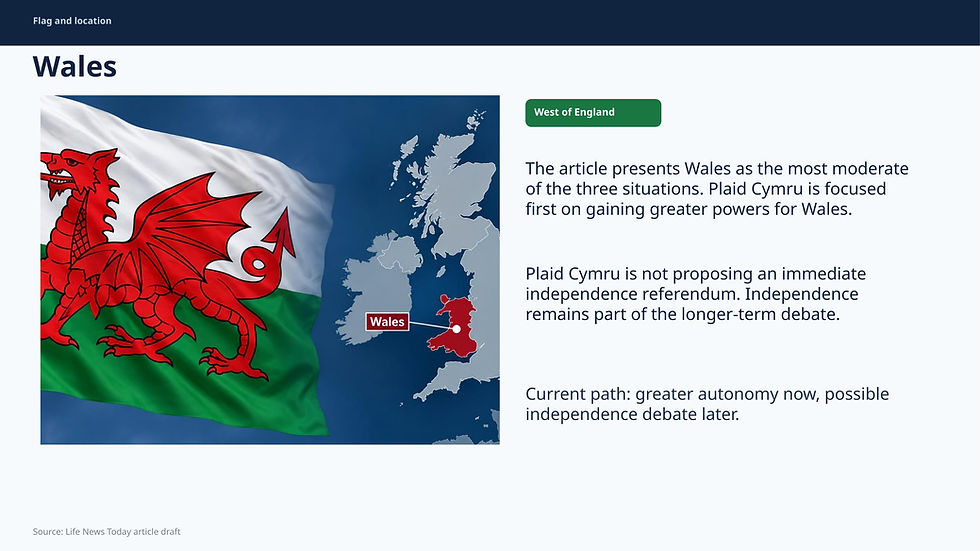
Wales, by contrast, is in a more moderate situation. Plaid Cymru made significant gains in the May 2026 Senedd elections and went on to lead the Welsh government, ending decades of Labour dominance. Its leader, Rhun ap Iorwerth, now participates more directly in the debate over self-determination, although the party is not proposing an immediate independence referendum. Its priority is also focused on securing greater powers for Wales. A Survation poll conducted for YesCymru, an organization that promotes Welsh independence, and published in September placed support for independence at 32% among likely voters who expressed a definite position, compared with 68% opposed.
Beyond the political and constitutional questions, any eventual separation would also require resolving practical matters such as defense and the division of facilities and resources. In Scotland's case, for example, London would have to negotiate what would happen to the bases, equipment and military personnel currently located there. One of the most sensitive issues would be HM Naval Base Clyde, where the submarines that form part of Britain's nuclear capability are stationed. It would also be necessary to determine what would happen to Scottish citizens currently serving in the United Kingdom Armed Forces and how certain facilities and resources would be divided. In Wales and Northern Ireland, any negotiations would have different characteristics because of their own political and military structures.

The Cardiff meeting ended with a memorandum of understanding among the SNP, Plaid Cymru and Sinn Féin that recognizes that each territory has different constitutional circumstances and objectives but maintains that their citizens should be able to democratically decide their future and calls on the British government to prepare to facilitate those processes rather than block them. The parties also agreed to maintain cooperation in areas such as economic development, energy and international relations, and agreed that they see the future of their nations within the European Union. The agreement does not establish a common timetable or create a legal mechanism for holding referendums, so each movement will continue along its own path: the SNP will continue calling for a new referendum on Scottish independence, Sinn Féin will pursue the mechanism provided for in the Good Friday Agreement for a potential vote on Irish reunification, and Plaid Cymru will continue advocating greater autonomy and, in the longer term, Welsh independence.
From Westminster, the government responded that British Prime Minister Andy Burnham continues to support the union and that his priority lies with other issues rather than new constitutional referendums. The meeting also drew criticism from unionist sectors in Northern Ireland, which questioned Michelle O'Neill's participation and emphasized that she attended as a Sinn Féin leader and not as a representative of the entire Northern Ireland Executive. For now, none of these movements has opened an immediate process of separation. The Cardiff meeting does, however, mark a new level of cooperation among three nationalist forces that, although pursuing different objectives, have decided to coordinate part of their strategy toward Westminster.\\

Written by
John Merolla, Reporter
Life News Today


Comments