


Bangladesh Has a New President

John Merolla
Life News Today
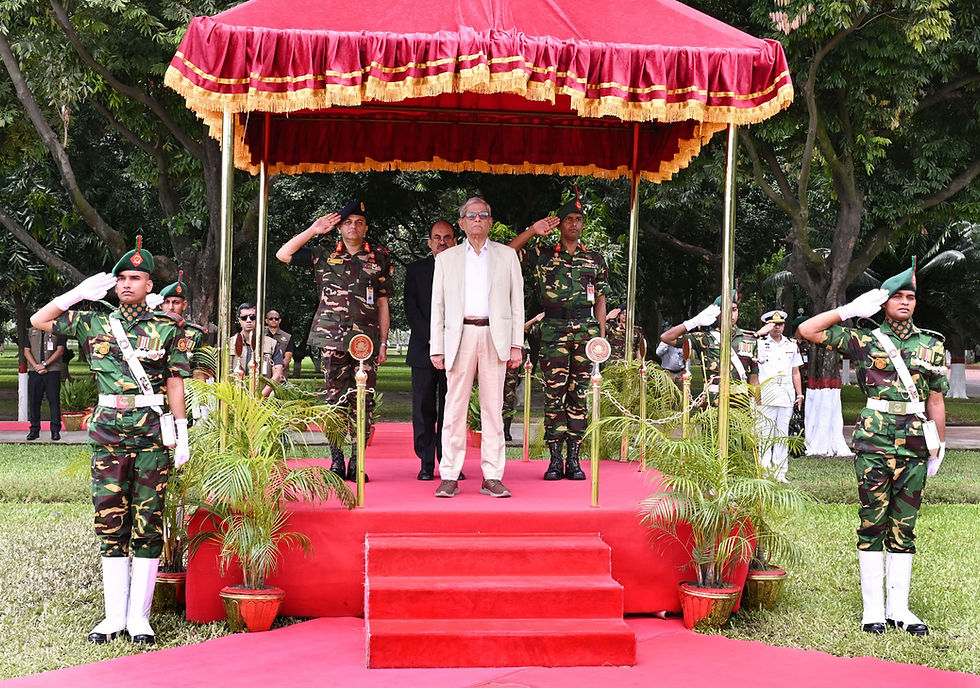
Mirza Fakhrul Islam Alamgir has secured the presidency of Bangladesh and became the country's 23rd president after receiving 255 votes in Parliament compared with 88 for his rival, Oli Ahmed. The election was held on August 20 and was the first presidential contest with more than one candidate in Bangladesh since 1991. Alamgir formally took office on August 21, opening a new chapter for a country that is still trying to rebuild its political life after the fall of Sheikh Hasina.

Bangladesh and its people are a society shaped by the coexistence of tradition and rapid modernization. With nearly 176 million inhabitants concentrated in a relatively small territory, Bangladesh is one of the most densely populated countries in the world. The great rivers, floods and cyclones are part of everyday life, but also of the national identity. A large part of the population maintains close ties to the countryside and agriculture, even as the major cities grow at a dizzying pace. Dhaka, the capital, is an immense, noisy and frenetic city, where modern buildings, traditional markets, mosques, universities and an enormous population that arrived from rural areas in search of opportunities coexist. Family and community carry significant importance, Bengali is a fundamental element of identity, and the culture is strongly expressed through literature, music and traditional celebrations. Although Bangladesh continues to face poverty and inequality, its social advances have been considerable over the past decades, especially in education, health, life expectancy and women's participation in the labor market.
The great engine of the economy is the textile industry. Bangladesh has become a global garment powerhouse and is currently the second-largest exporter of clothing in the world. The sector accounts for around 81 percent of exports and employs millions of workers, while also having been an especially important source of employment for women. This model allowed millions of workers to move from low-productivity agricultural activities into industrial jobs connected to international production chains. For many women, it also meant a profound social transformation by giving them access to their own income for the first time and greater economic independence. But this success also creates dependence, and the country needs to diversify its exports, improve productivity and create higher-quality jobs. Inflation, informality and poverty remain important problems, while the economy must prepare to compete in an increasingly demanding international environment. Bangladesh achieved an extraordinary economic transformation, but it still faces the challenge of turning that growth into broader and more stable prosperity.

Politics, however, has been much less stable. Bangladesh was born as an independent state in 1971, after a war against Pakistan, and its first great leader, Sheikh Mujibur Rahman, was assassinated in 1975. The following years were marked by military coups and authoritarian governments until the restoration of the parliamentary system in 1991. Since then, politics has been dominated by an almost permanent rivalry between two major forces, the Bangladesh Nationalist Party (BNP), founded by President Ziaur Rahman and later led for decades by his wife Khaleda Zia, and the Awami League, led for decades by Sheikh Hasina, the daughter of Mujibur Rahman. The competition between the two groups was marked by strikes, election boycotts, allegations of fraud, imprisonments and polarization that ultimately affected practically every aspect of political life. During Hasina's 15 years in power, Bangladesh experienced economic growth and advances in infrastructure, but allegations of authoritarianism, corruption and repression against the opposition also increased.
The turning point came in 2024. What began as student protests against a job quota system ended up becoming a massive mobilization against the government. The violence and repression left a death toll that the United Nations later estimated at as many as 1,400 people between July and mid-August, and Hasina eventually fled to India. Subsequently, the activities of the Awami League were banned and its electoral registration suspended, preventing it from participating in the elections, while the country came under an interim government headed by Nobel laureate Muhammad Yunus. General elections were finally held in February 2026, and the BNP won a decisive victory. Tarique Rahman, who had returned to the country after about 17 years abroad, assumed the post of prime minister. The result reflected the enormous rejection that had accumulated against the former power structure and the desire of a significant part of the electorate to definitively close the Hasina era.

The August presidential election must be understood within this new balance. In Bangladesh, the president is not elected directly by the citizens, but by Parliament, and the president's duties are mainly ceremonial, although the officeholder also formally serves as commander in chief of the Armed Forces. Alamgir, 78, is one of the BNP's longtime leaders and served for years as the party's secretary general. His rival, Oli Ahmed, was backed by an 11-party opposition alliance led by Jamaat e Islami. The result, 255 votes to 88, was decisive and reflected the enormous parliamentary majority that the BNP had secured months earlier. It also carried symbolic significance, as it was the country's first competitive presidential election in 35 years.
Alamgir assumes the presidency as Tarique Rahman's government faces the task of rebuilding institutions, confronting polarization and sustaining an economy that needs new sources of growth. Bangladesh will also have to balance its relations with India, where Sheikh Hasina remains, with its economic ties to China and with Western countries that are essential markets for its textile industry. Political change, therefore, does not guarantee a profound transformation by itself. Bangladesh has an enormous opportunity ahead of it, but also a familiar risk, that the historic dispute between its main political forces could once again turn into a cycle of confrontation. After years of crisis, the true success of the new government will not be measured only by how long it remains in power, but by its ability to demonstrate that the country can finally change governments without falling back into the same old fight.


Comments