


Floods in Thailand Leave Dozens Dead and Millions in Losses

Thailand is facing a severe flooding emergency after weeks of heavy rainfall that began on September 16. The downpours caused rivers, canals, and drainage systems to overflow, affecting millions of people across much of the country, including the capital, Bangkok. As of October 14, authorities had recorded at least 72 deaths and more than 4.23 million people affected since the beginning of the emergency. Although floodwaters have begun to recede in many regions, approximately 2.45 million people and more than 905,000 households remain affected across 20 provinces and Bangkok.
One of the most critical periods occurred between September 25 and 27, when Bangkok received approximately 320 millimeters of rain in just two or three days, an amount close to what the city normally receives during an entire month. Streets in several neighborhoods were submerged, hundreds of homes were affected, and many residents were forced to leave their homes or seek shelter in evacuation centers. Since then, water levels have begun to fall in the capital, although approximately 329,000 households remain affected. In neighboring Pathum Thani province, north of Bangkok, flooding continues to affect nearly 249,000 households across its seven districts.

The situation also disrupted operations at Suvarnabhumi International Airport, one of the country's main gateways, as many employees struggled to reach their workplaces. Thai Airways announced on September 29 that it would reduce approximately 30% of its scheduled departures from Bangkok, equivalent to about 30 flights, while roughly 5,600 pieces of luggage remained unprocessed. Transportation problems also extended to the road network, where authorities identified 74 affected highway sections across 13 provinces, including nine that remained completely impassable. Emergency teams were deployed to manage traffic, mark dangerous routes, and assist motorists.
The flooding resulted from a combination of particularly intense monsoon rains and weather systems that increased water accumulation across different regions. Conditions became especially difficult in the Chao Phraya River basin, one of the country's most important areas, where rising water levels forced authorities to carefully manage reservoirs and water releases. Large volumes of water moving south from northern Thailand into the central plains prolonged the flooding even after the heaviest rainfall had subsided. In provinces such as Phitsanulok and Phetchaburi, water levels continued to rise while other regions began showing signs of improvement.
Bangkok also faces a structural challenge. Much of the city lies in a low-lying area near the sea, so when rainfall exceeds the capacity of drainage systems, water can accumulate rapidly. Urban development has also reduced some of the natural areas that previously helped absorb or store excess water. The World Bank has warned for years that flooding represents one of Thailand's greatest natural hazards and that climate change could increase the severity of certain extreme weather events. Bangkok's main economic districts have remained relatively protected from additional flooding, although authorities continue monitoring rivers and canals because of the possibility of further rainfall.

The emergency has also renewed debate over whether better preparation could have reduced some of the damage. No infrastructure can guarantee that a city will remain completely protected against exceptional rainfall, but certain measures can significantly reduce its impact. These include maintaining and expanding canals, installing higher-capacity pumping stations, improving early warning systems and flood-risk maps, and adopting urban planning policies that preserve areas where excess water can be temporarily stored. Authorities have used pumps and specialized machinery to accelerate drainage, while emergency crews continue working in communities that remain flooded.
In response to the emergency, the Thai government approved approximately 4.1 billion baht, equivalent to about $122 million, in late September to provide immediate assistance to affected families. It also authorized a project worth approximately 160 billion baht, or $4.8 billion, to construct a flood diversion canal connecting Chai Nat, Pa Sak, and the Gulf of Thailand. The project, scheduled to begin in 2027 and take eight years to complete, aims to reduce flood risks in the central region and improve water storage capacity during dry periods.
Meanwhile, financial assistance has already begun reaching affected households. The Government Savings Bank transferred approximately 2.41 billion baht, equivalent to about $74 million, to 306,384 households across 39 provinces. Another round of compensation totaling nearly 645 million baht was scheduled to benefit an additional 86,303 households, including almost 75,000 in Bangkok. The assistance is intended to cover part of the immediate losses, although damage assessments are still underway.
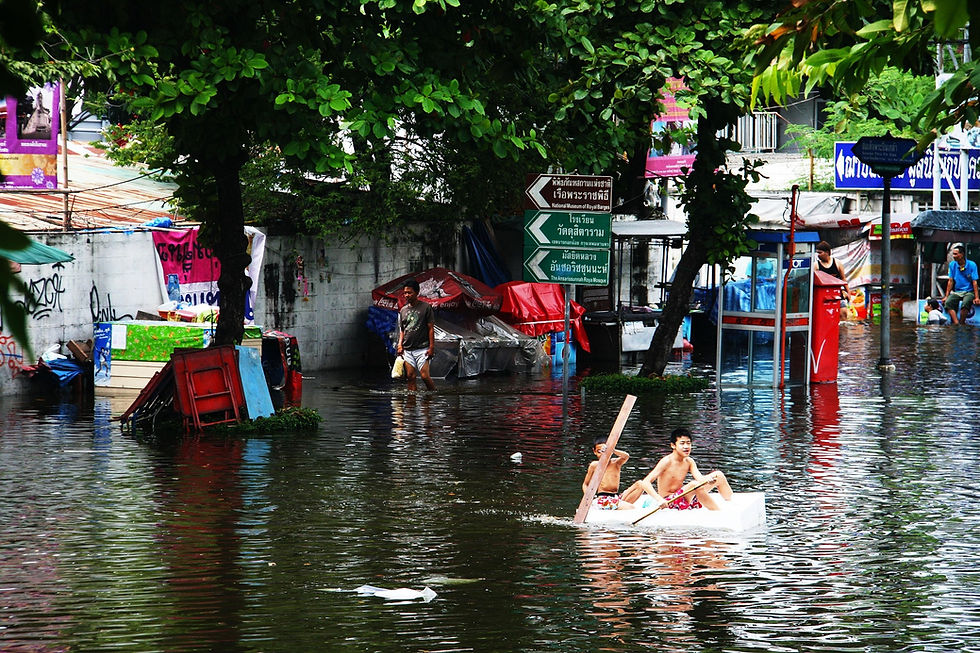
The economic impact is already considerable. Initial assessments placed damages at approximately $367 million across roughly two dozen provinces, a preliminary figure that does not represent the total cost of the emergency. Losses could increase as assessments of homes, businesses, roads, infrastructure, and agricultural land continue. An analysis by the SCB Economic Intelligence Center estimated that the floods could reduce Thailand's economic growth by between 0.05 and 0.1 percentage points in 2026. The institution also calculated that more than 1.69 million workers had been affected by transportation disruptions, temporary business closures, and lost working hours.
Among those hardest hit are workers who depend on daily wages and small businesses, which often lack sufficient resources to withstand prolonged closures or replace damaged equipment and merchandise. The difficulties also extend to the service, retail, and manufacturing sectors, where disruptions can affect both production and supply chains. According to SCB EIC, the economic recovery will depend partly on the ability of families and businesses to obtain financing and resume their activities.
Tourism is another particularly vulnerable sector, especially because Thailand depends heavily on international visitors. Between January and September of this year, the country received 21.28 million international tourists, a 3.12% decrease compared with the same period in 2025. Additional disruptions to flights and transportation could further complicate the industry's recovery. Although the decline began before the worst flooding, transportation difficulties present another challenge for hotels, restaurants, and other tourism-related businesses. Industry authorities have also expressed concern about the potential impact on Chinese visitor arrivals during one of China's major holiday periods.

Public health is another concern. In an assessment conducted on September 28, the Ministry of Public Health reported that 49 healthcare facilities had been affected by flooding, with 22 forced to close temporarily and another three partially suspending services. In some areas, patients had to be transferred, and medication supplies had to be organized to maintain medical care. Authorities said many of the deaths were linked to drowning and electrocution, while contaminated water, mosquito proliferation, and difficulties accessing medication and medical services pose additional risks. The ministry also implemented emergency measures to ensure hospitals could continue operating and vulnerable populations could receive care.
Thailand is already familiar with the consequences of large-scale flooding. The most significant previous disaster occurred in 2011, when floods affected more than 13 million people, caused over 680 deaths, and resulted in an estimated $46.5 billion in damage and losses. That emergency hit the industrial sector particularly hard. Major industrial areas in Ayutthaya and Pathum Thani were submerged, forcing numerous factories to suspend production and disrupting international supply chains. According to the World Bank, manufacturing accounted for approximately 70% of the economic damage and losses caused by that disaster, whose consequences extended far beyond Thailand's borders.
The situation in 2026 differs significantly from that catastrophe. According to SCB EIC, the volume of water flowing south from northern Thailand is considerably lower than in 2011, when flooding paralyzed major industrial centers for several months. Although current economic losses remain far below those recorded during that disaster, the emergency continues to affect numerous communities, particularly in the central provinces and areas surrounding Bangkok.

Thai authorities continue removing accumulated floodwater, distributing assistance, and assessing damage in regions where flooding has begun to subside. While some neighborhoods are gradually returning to normal activity, thousands of families still face difficulties returning to their homes or resuming work. The final cost of the emergency remains unknown, and recovery efforts will continue as floodwaters recede in the hardest-hit areas.
John Merolla,
Life News Today


Comments