


China’s Africa Loans Build Roads, Debt and Power

Alexander Fernandez
Reporter, Life News Today
Chinese lenders have financed Africa’s infrastructure, signing $181 billion in 1,319 loan commitments over 24 years. These projects addressed key needs but attached revenue and financial accounts to lenders, tying African movement and development to Chinese influence long after construction.
Building on those financial relationships, AidData found that Chinese lenders often safeguard loans through cash flow controls rather than physical assets. Their research traced 620 public debt transactions worth $418 billion in 57 countries. Borrowers send export revenues to accounts that AidData says are “out of public sight and largely beyond their control” until debt is repaid. Christoph Trebesch of the Kiel Institute said Chinese lenders “want visibility and control over revenue streams.” Governments may own infrastructure, but revenue is routed through accounts designed to ensure repayment.

Uganda borrowed $200 million from China Eximbank to fund the upgrade of Entebbe International Airport, according to AidData. The airport near Kampala added a cargo terminal, upgraded runways and lighting, expanded the terminal, repaired aprons, improved navigation aids, and built a multistory parking garage. Some claimed China could seize the airport if Uganda defaulted. However, AidData found the contract did not list the airport as collateral. Instead, the lender required cash in a reserve account and airport revenues in a sales account, stressing financial mechanisms over physical assets.
This arrangement meant that Entebbe stayed in Ugandan hands while airport revenue moved through accounts designed to protect repayment. AidData said the loan was secured by a minimum cash balance in a dollar-denominated repayment reserve account and by revenues deposited in a sales collection escrow account. Further, China Eximbank also sought authority over the Uganda Civil Aviation Authority's annual budgets, the agency responsible for the airport, before accepting a less intrusive arrangement that allowed the lender to monitor spending decisions rather than control them. Similar repayment structures can appear in loans tied to port fees, road tolls, railway revenue, commodity income, or restricted repayment accounts, illustrating a broader pattern across projects.

The importance of these transport systems is magnified by Africa’s mineral reserves, tying infrastructure projects to global supply chains. The United States International Development Finance Corporation (DFC) said advanced technologies depend on reliable access to copper and cobalt, which are essential for batteries, wind farms, electric vehicles, and energy transmission. The agency said companies based in China own or operate as much as 80% of critical mineral production in the Democratic Republic of Congo (DRC), much of which is sent to China for processing. The DRC is the world’s largest cobalt producer, with a 70% global market share, and the second-largest copper producer, according to the DFC. Transport systems connect those mines to factories, power systems, and defense supply chains that depend on those materials, linking infrastructure investment to global technology and security needs.
In response to these challenges and global interests, the United States has backed the Lobito Corridor, a rail and port route intended to move minerals from central Africa toward the Atlantic. In December 2024, the DFC announced a loan commitment of up to $553 million to upgrade the Lobito Atlantic Railway, including rehabilitation of the mineral port in Lobito and about 1,300 kilometers of rail in Angola between the Lobito port and Luau, near the DRC border. DFC CEO Scott Nathan said the corridor was “advancing key United States strategic interests,” while then-President Joe Biden called it “the biggest American rail investment outside of America.” The DFC said a railway more than 100 years old once connected mining sites in the DRC to the port of Lobito in Angola, but war, poor construction, and weak upkeep left minerals moving by heavy trucks to ports in South Africa and Tanzania over roads that could take months to travel. The upgraded rail, port, and sea route is expected to cut export costs for critical minerals by 30% on average, reduce travel time by 29 days, and raise Lobito’s transportation capacity from 0.4 million metric tons a year to 4.6 million metric tons, according to the DFC.
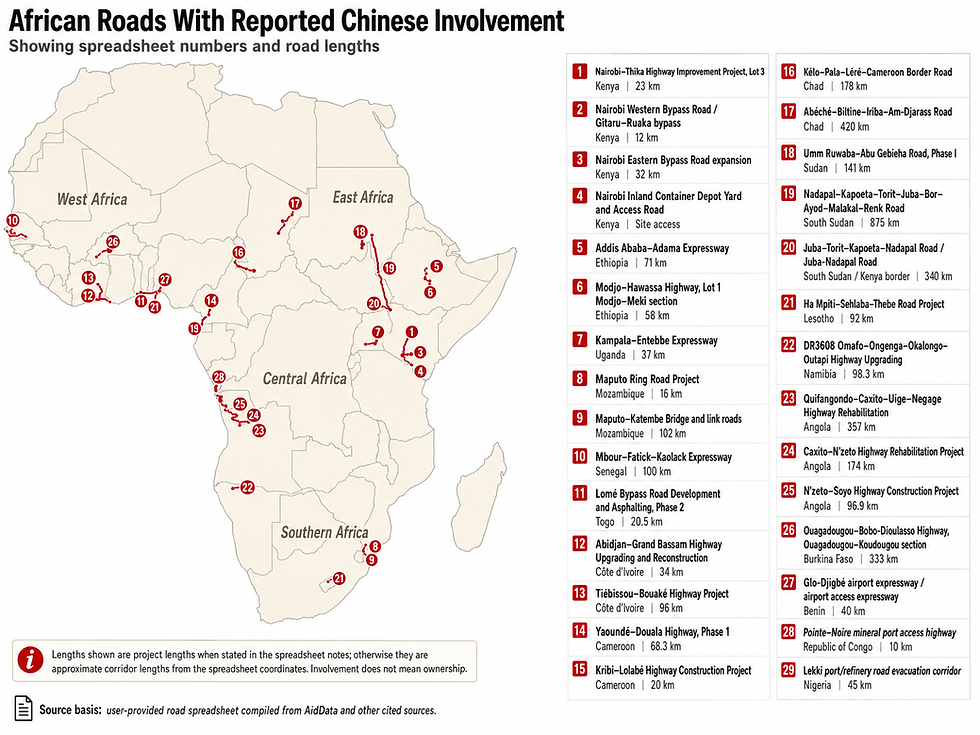
A similar intersection between infrastructure and strategy is evident in Djibouti, where commercial infrastructure and a military presence overlap along the Red Sea and the Gulf of Aden, connecting Africa, the Middle East, and global trade. The Congressional Research Service (CRS) has described Djibouti as the site of the only permanent U.S. military base in Africa and China’s first overseas military base. CRS said China’s engagement in Djibouti includes major infrastructure investments and a military presence near strategic shipping routes. Ports, airports, and railways can carry commercial traffic in ordinary times and support military movement during a crisis, reinforcing the idea that infrastructure underpins both economic and security aims.
Building on these strategic developments, mineral corridors, port contracts, and processing networks can affect the prices and availability of batteries, clean energy projects, vehicles, phones, power grids, and military systems. United States businesses can also enter African markets after Chinese companies have already secured contracts, established financing relationships, and built an infrastructure footprint. Companies that finance and build transport and processing systems often remain positioned for later contracts, financing relationships, and market access, reinforcing their long-term influence.

Against this backdrop, many African leaders choose Chinese financing because they need roads, ports, railways, power plants, and other projects, and Western financing can be slower, smaller, or tied to conditions they consider burdensome. Some Chinese-backed projects have helped move goods, connect cities, and expand trade. Not every Chinese loan is harmful, and not every Western alternative arrives fast enough to meet local needs. Uganda’s negotiations over Entebbe showed borrowers can push back when terms become too intrusive. Contract terms become more consequential when repayment conditions are difficult to see, difficult to renegotiate, and painful when debt payments rise, connecting lenders' choices to practical outcomes for local governments.
Even without formal ownership, indebted infrastructure gives lenders ongoing leverage. Debt terms, project revenue, and later negotiations let China’s financiers shape broader business, diplomatic, and military access in Africa long after initial builds. Debt and contract terms keep lenders tied to African infrastructure, impacting supply chains, shipping, and diplomacy beyond a single country. In the United States-China competition, transport projects anchor lasting influence over key resources and regional access.


Comments