


McCormick 2026 Flavor of the Year Black Currant Bundle

Updated: 6 hours ago
Hey there hep cats and kittens, it’s your pal The Reckless Gastronome. Okay, I have no idea what young, hip, and avant garde people use to refer to each other (flameo hotman?), but I probably should try to avoid it. The only reason I’m even trying is because today I’m reviewing the 2026 flavor of the year. The McCormick spice company, since 2000, has released a flavor of the year in an attempt to predict or influence tastes. I guess it only logical for the makers of tastes to become tastemakers (I swear that makes sense in my head). It’s kind of like what Pantone does with colors. Unfortunately, it hasn’t really caught on, but that may be partially because it’s only been the last four years that they promote a spice or sauce, before that it was a lot of abstract concepts “Time” or “Plants”. Not exactly the kind of thing that a layperson is going to latch onto. This is also the first time that I’ve run into the Flavor or the Year in the wild (ok, not the wild, but a grocery store). I had picked up a jar but hadn’t gotten around to tasting it when I received a box from a “fan”. Maybe it really was a fan that sent it (in which case, thank you), but I suspect it was from McCormick themselves. That’s fine, I’ll be your dancer for money, I’m a sucker for a fancy box. And what a fancy box it is! Crinkly paper, solid cardstock, a magnet to keep it closed. I’m feeling spoiled. If I had any sort of production skills, I would have done an unboxing video like a real influencer (I tried, but between dropping my phone and my raspy breathing, it wasn’t meant to be).

If you are living in the States, you might be asking just what black currant is and why should I give it a chance? For those of you living in Europe, you are probably wondering why don’t Americans know about it? I’ll answer all these questions and probably a couple more. What I won’t answer is how to pronounce it, because I can’t seem to say it right (whether it’s because of my accent, my damaged voice box, or the fact that I almost never hear it spoken out loud and learned it from reading, I can’t tell; no clue if my digital simulacrum will say it right). Black currant (Ribes nigrum also known as cassis) is a berry that grows on a hardy shrub in Europe and Northern Asia. The taste is tart and tangy with a subtle herbal taste and is slightly astringent. Some say it tastes a bit like a blend of blackberry, cranberry, and tart cherry. Fresh berries are used in jams and syrups, dried berries are found in baked goods as an alternative to raisins (you may have seen in baked into Irish soda bread) and made into beverages like Ribena (popular in the UK, but I have seen it in stores rarely) or in Crème de Cassis (I have a bottle of this that has been living on my bar for so long that it’s old enough to drink itself). It’s also really high in Vitamin C if you are worried about scurvy (and who isn’t?). Generally speaking, if you find a dark purple candy in Europe, it’s going to be black currant and not grape (even for traditionally American brands like Skittles).

So why don’t we have black currants in the States? Well, you see, black currants can only be measured with the metric system, and therefore cannot be imported here. That’s a bald-faced lie. Black currants used to be popular here before the 20th century, but unfortunately the plant itself is a vector for white pine blister rust which is a fungus-based disease (and sounds like a Metal/Western fusion band). It was banned in the United States in 1911 mostly to protect logging interests, but considering both blackcurrants and the fungus aren’t native to North America (black currants were brought to Massachusetts in 1629 and the fungus was accidentally introduced from Asia around 1900) I’m fine with them prioritizing trees. While the national ban was ended 1966, many individual states continued to ban it until 2003 relenting now that better fungicides and fungus resistant varieties are available.
Now seems as good a time as any to bring it back into the spotlight, and to that end McCormick has two new spice blends to showcase its versatility. A finishing sugar (a coarse sugar designed to add color, texture, and flavor frequently added after preparation) and a sweet and smoky blend meant for savory dishes. To test both spices, I’ve put them through a battery of tests and even press ganged a couple of friends into an impromptu tasting party.
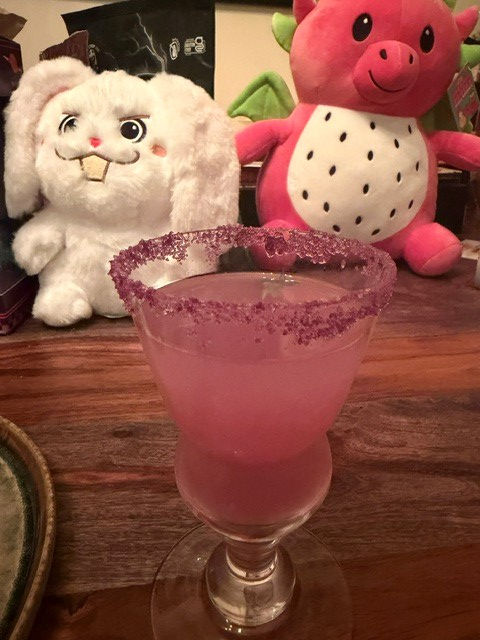
We will start with the more straight forward of the two, the finishing sugar. It’s sweet, it’s crunchy, it’s purple. It’s really nailing it so far, but let’s go a bit further. I took inspiration from the McCormick website and made a Black Currant Lemonade. I say took inspiration, meaning that I couldn’t be bothered to make the recipe from scratch, so I just used a premade 1.75 Liter lemonade, and added four Tablespoons of the finishing sugar (yes, I mix and match measurement systems). Then to make it fancier I rimmed the glass (stop laughing, that’s what it is called), but I’m not very good at evenly rimming, as my spouse can attest (what?), it’s just not a job I’m good at (you caught me, I’m doing it on purpose). I actually made up three big bottles of it to serve at a party (I had to pick up additional jars, well played McCormick) and it was a big hit, even without a rimming (yeah, I still find it funny). General consensus is that it cuts the acidity and the sweetness (not sure how adding more sugar makes it less sweet, but it somehow does) and imparts a fruity and slightly herbal depth to the flavor. It almost felt like a cocktail, and I think it would excel in such a use, but I would suggest making it into a simple syrup (equal parts water to sugar) before adding it to alcohol to keep it from making the drink feel gritty. It’s hard to say how closely it tastes to the fresh fruit, since they aren’t available in my region, but it does line up with the candies I’ve had.

Now for the Sweet and Smoky Seasoning. Reading the jar, it mentions having toasted onion, aged red jalapeño and oak smoke. It sounds rather complex, so I thought I should give it a complex test. I decided not to cut corners (I’m not always lazy, just most of the time), and made the Black Currant Smashburger Sliders and this time I actually followed the recipe (also from the McCormick website). It had four main parts, Black Currant Mayo, Red Cabbage Slaw, Black Currant Glaze, and the Sliders themselves (which are also seasoned). I could go into detail into making each part, but this is already getting a bit wordy, so just check out their website. Each component is good on their own, but it gets a little bit strong when put together. The flavor is surprisingly piquant, with red and black pepper coming in first, then a bit of sweetness, followed by the smoky suffusing your mouth, and then it returns to a full spicy sensation. I wouldn’t say that it gets unbearable, but the spice can build up if you go too fast. If you decide to try the recipe yourself, I would suggest making the glaze with the finishing sugar instead of the seasoning, and also letting all the parts rest for a day (I cooked half one day and then finished it off the next), it allows the flavors to blend more and more balanced. Once again, it’s hard to know just where the black currant begins and the other flavors end, but viewed as a whole it’s a really good blend.
So, is black currant the flavor of 2026? Unfortunately, I haven’t seen any other foods at restaurants or any other companies capitalizing on it here, so it seems unlikely, but that doesn’t mean that it can be ignored. Perhaps this will bear fruit (or berry fruit as the case may be) down the road. Prognostication is hard, I was convinced that peri-peri was going to the next big thing after chipotle peppers, but other than a couple Nando’s opening up, it never really took off. Still, I appreciate the effort needed to find the next big thing and look forward to 2027’s Flavor of the Year.
Sent to me directly from McCormick, but found at Safeway as well.

Written by
The Reckless Gastronome
Martin Peyruc, Reporter
Life News Today



Comments