


Where Did the Park's Wood Go?

Updated: Oct 7
Hazard-tree projects remove trees considered a safety risk because they are dead, dying, damaged or otherwise likely to fall, and they can include trees that are still alive. At Lewis and Clark State Park in western Iowa, officials approved a contract worth up to $1.7 million for approximately 610 mature trees in the campground and additional hazard trees across 98.5 acres. Residents said they received no advance warning of that scale, and records reviewed by Life News Today did not identify where the logs went or what they were worth.

The Iowa Department of Natural Resources (DNR) said the trees were not healthy. Sherry Arntzen, then chief of the agency's State Parks, Forests and Preserves Bureau, said an examination of 137 representative trees found crown dieback in 99 percent of the park's eastern cottonwoods, with 10 percent already standing dead. She attributed the decline to age and prolonged drought and said a tree with at least one-fourth of its canopy gone was unlikely to survive and was classified as a hazard, according to Radio Iowa's report of her commission testimony. The state's request for proposals described every tree included in the project as dead or dying with more than 50 percent crown dieback. The public documents reviewed contained the sampling result and the projectwide description, but no individual condition list for the trees in Phase 2.

Phase 1 called for approximately 610 mature trees in the campground and other high-use areas. Phase 2 expanded the work to all hazardous timber within 150 feet of hiking trails and roads, covering about 98.5 acres. The reviewed records did not include a total tree count for Phase 2.
In October 2024, DNR announced an open house on tree removal and a timber sale and described several hazardous cottonwoods near the campground. A September 2025 closure notice told campers that dead or dying trees would be removed and said reservation holders had been contacted. Neither notice stated the later figures of roughly 610 trees and 98.5 acres.

DNR later told commissioners that it used several methods to communicate with the affected community, but the commission minutes did not identify those methods. The minutes recorded no public comments or written comments before commissioners approved the contract without a recorded nay vote. Life News Today found no publicly posted attendee list, transcript or comment summary from the 2024 open house.
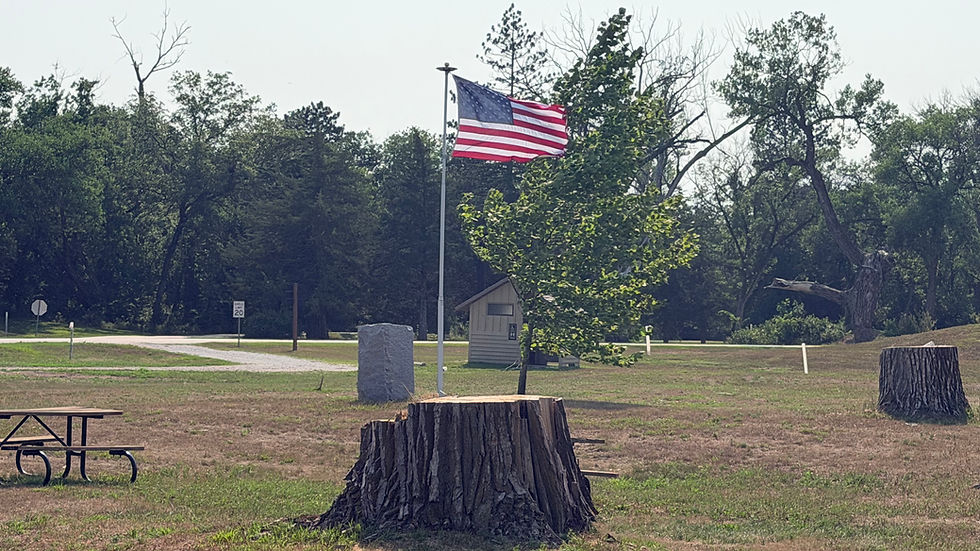
One local woman walking through the cleared park told Life News Today that machinery and trucks seemed to appear overnight. She said she had received no advance notice of work on that scale and that residents would have fought for the park had they known. Other residents interviewed at the site also said they learned the project's reach only after the equipment arrived. Life News Today photographs, all taken after the cutting, showed open ground, stumps and large logs stacked in organized piles. The photographs did not show the trees before removal.

The 2024 notice called the event a timber sale. The later contract required crews to fell trees, grind stumps and transport or dispose of woody material. Arntzen told commissioners that all removed trees would be taken offsite. The state selected Armodus LLC for the work. A July 10, 2026, Iowa DNR list identified the company as a bonded timber buyer, and a state rule defined that business as one that buys timber for processing or resale, including shared-profit harvests. Nothing in the reviewed files established that Armodus bought or sold the park logs, and the records contained no finding that the company improperly profited from them.

The National Park Service's servicewide fuels manual requires managers to consider the market value of removed vegetation. When removed material has fair-market value, the manual requires managers to account for that value and, in certain circumstances, execute a separate timber or vegetative sales contract. Federal law also directs proceeds from certain National Park Service timber sales to the U.S. Treasury. Those federal rules do not govern Iowa state parks. In 2023, Sequoia and Kings Canyon National Parks approved work on 12,000 to 15,000 tree hazards after wildfire and publicly described several ways the resulting wood could be handled, including treatment onsite, hauling material from the parks and making some wood available for public use by permit. The reviewed Lewis and Clark files did not identify the wood's destination, buyer, mill, sale price, contractor credit or state revenue. They included no scale tickets, bills of sale or receipts tied to the logs.
Lewis and Clark State Park reopened July 17. DNR said hundreds of dead or dying cottonwoods had been removed and reservation photographs no longer reflected current conditions. Replanting had begun, while lower-use work could continue into 2028. The agency told visitors that shaded campsites remained limited.
Written by
Alexander Fernandez, Investigative Journalist
Life News Today


Comments